Interpol made one of the truly greatest records of their era. Turn on the Bright Lights was a tour de force that brought post punk into the modern era–a breakthrough that is still going strong today (Neon Trees does nothing but put Interpol songs through a top 40 machine). Unfortunately, that sort of impact would cast a long shadow on the rest of their career.
Record #209: Interpol – Turn On the Bright Lights (2002)

Back in the early aughts,a bunch of bands said, “you know what? Joy Division was really good” and decided to bring post punk back. This was an excellent decision.
Turn on the Bright Lights stands as probably the best testament to that. This record is a definite classic, attached to its moment in time (post 911 New York), yet timeless.Paul Banks’ vocals harken back to the post punk and new wave of the 80s while guitars and drums chop with frantic efficiency alongside some of the best bass lines ever composed.
From the opening guitar tremolos to the reverb that rings out at the end of “Leif Erickson,” TOTBL is a perfect statement, and one that would haunt the band for the rest of their career.
Record #208: Huey Lewis and the News – Sports (1983)
You said it, Bender.
Record #207: Hot Hot Heat – Make Up the Breakdown (2002)
If you don’t think this record is great, you’re wrong. It caught my ear upon its arrival when my family had cable and Fuse still played music. I was a tenth grader with Dashboard Confessional, Finch, and Thursday in my CD player when I first saw a crazy music video by a bunch of moptops called Hot Hot Heat playing a song called Bandages.
Record #206: Gustav Holst – The Planets (1962)
Most of my classical collection has been exempt from this project on account of my lack of knowledge on the subject (and the time commitment required). However, there is one classical work with which I have a long standing intimate knowledge of: Gustav Holst’s The Planets. Continue reading
Record #205: Fugazi – Margin Walker (1989)
And the gaps in my Fugazi collection continue to grow smaller (one remains, if you’re not counting Instrument Soundtrack as a true album, which I don’t). Margin Walker, their second EP, sees the fearless foursome showing a drastic leap forward in composition that makes Repeater look like a step back.
Record #204: Heavenly Bodies – Celestial (1988)
Sometimes, it’s possible to predict how a record will sound using context clues. And judging by the band name, song titles, astral-philic record cover, and release date, it’s easy to tell what Heavenly Bodies’ sole release would sound like.
Record #203: Collections of Colonies of Bees – GIVING (2011)

In my last CCoB post, I likened the way they built their compositions to a game of Jenga–elements are added then removed and placed elsewhere until they can go no higher (higher in terms of form, not in terms of emotional climax, which they don’t trouble themselves with).
On GIVING (their first release after being brought to a wider audience by Volcano Choir, the band they’re in with Bon Iver’s Justin Vernon) the game is a little more direct.
The pieces aren’t as oddly shaped as on Birds, nor do they shy away from sudden dynamic shifts like their brothers on the other end of post rock, Explosions in the Sky. In fact, the end of “Lawns” might even find a place in a movie trailer some day—but for an art house indie drama rather than a football movie.
That’s not to suggest (as some have) that GIVING finds CCoB taking the easy way out. There’s still plenty avant-garde textures: “Lawns” itself has a strange vocal part created on a sampler. “Vorms” features an interlude of no fewer than a dozen looped instrument).
In the end, GIVING is just as masterfully crafted as Birds, deciding instead to use combine that experimentation with more immediacy.
Record #202: Collections of Colonies of Bees – Birds (2005)
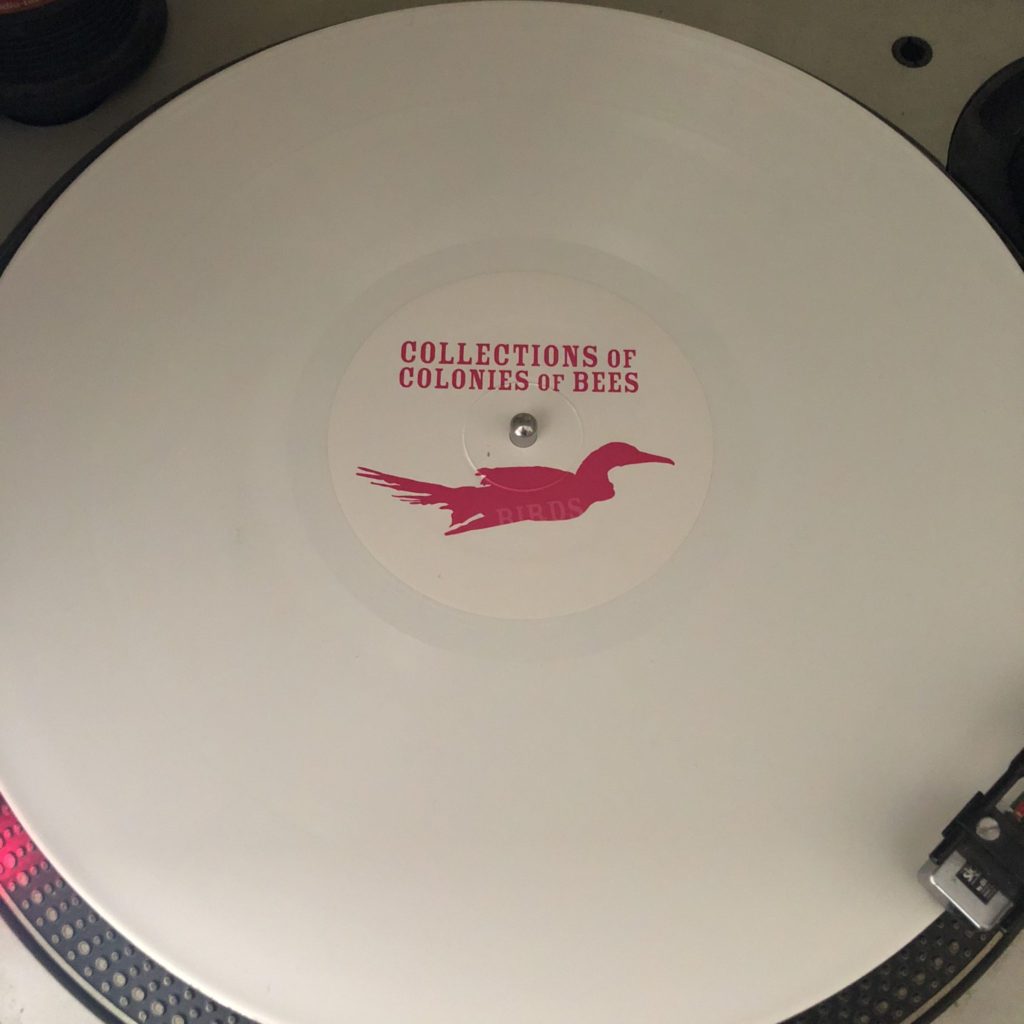 Genre classification is an imperfect science.
And nowhere is that quite as apparent as within post rock. It is a beast with many heads, with some of the heads so disparate that their inclusion in the same section in the record store (or subfolder in iTunes) seems like an anomaly in the Pandora database. After all, what fellowship can Stereolab have with Godspeed You! Black Emperor? Russian Circles with Tortoise? Continue reading
Record #201 – Collections of Colonies of Bees – Customer (2004)

I got through about ten minutes of this record without realizing it was playing at the wrong speed.