Record #407: Joe Zawinul – Zawinul (1971)

As I’ve mentioned in the last few reviews, I’ve been digging deep into Miles Davis’ electric period lately. And my deep, I don’t just mean that I’ve been giving In a Silent Way and Bitches Brew repeated listens—I’m also getting into what his sidemen in those albums were doing at the same time. 

While John McLaughlinHerbie Hancock, and Chick Corea have all been loudly celebrated, maybe the most influential voice in those sessions were that of Joe Zawinul. And while it’s easy for anyone to be forgotten in the twin shadows of Herbie and Chick, one listen to this album makes it obvious that Zawinul was running things from those shadows...
As Miles himself writes in the liner notes, Zawinul is an expansion of Joe and Miles’ experiments on In a Silent Way and Bitches Brew. And he is not exaggerating. This album has the same spacey atmospheres and frenzied energy as those albums. All that’s missing is Miles’ trumpet (even Wayne Shorter makes an appearance). 

The tracks are masterful composed and deftly played. Especially the two longer tracks, “Doctor Honoris Causa” (From the liner notes: ”Dedicated to Herbie Hancock for his Honorary Doctorate at Grinnell University in Des Moines, Iowa”) and “Double Image” (”A concept of what man thinks he is as opposed to what he really is”). “Doctor Honoris Causa” is a patient work of ambience that unfolds through a slow modal pattern with a steady, gentle drum pattern, gaining momentum as it goes. “Double Image” is a frenetic Bitches Brew style free-for-all that would make it onto Live-Evil. Both tracks are equally effective, showcasing the duality of man Joe was talking about.

Between these two ten-minute-plus tracks are two shorter pieces. Joe’s own version of his composition “In a Silent Way” (what did I tell you? Mastermind. Also, “Impressions of Joe Zawinul’s as a shepherd boy in Austria”) and “His Last Journey” (”A tone poem reminiscent of his grandfather’s funeral on a cold winter day in an Austrian mountain village”). Each are warm, transcendent ballads that ride the line between tunes and soundscapes—years before anyone would throw around the term “soundscape.”

As if the four tunes before weren’t already abstract enough, the closer “Arrival in New York” takes it even further. It’s just shy of two minutes of tape loops and manipulated recordings meant to mimic the sound of traffic and foghorns, described in the liner notes as “Joe Zawinul’s first impression of New York when he arrived here as a boy on a ship from France.”

And while Joe’s contributions to Miles’ work would be enough to warrant any jazz fan’s attention, it’s important to note that Joe is also the mastermind behind the fusion group Weather Report, who also released their debut in the same year. Not bad for a shepherd boy from Austria.
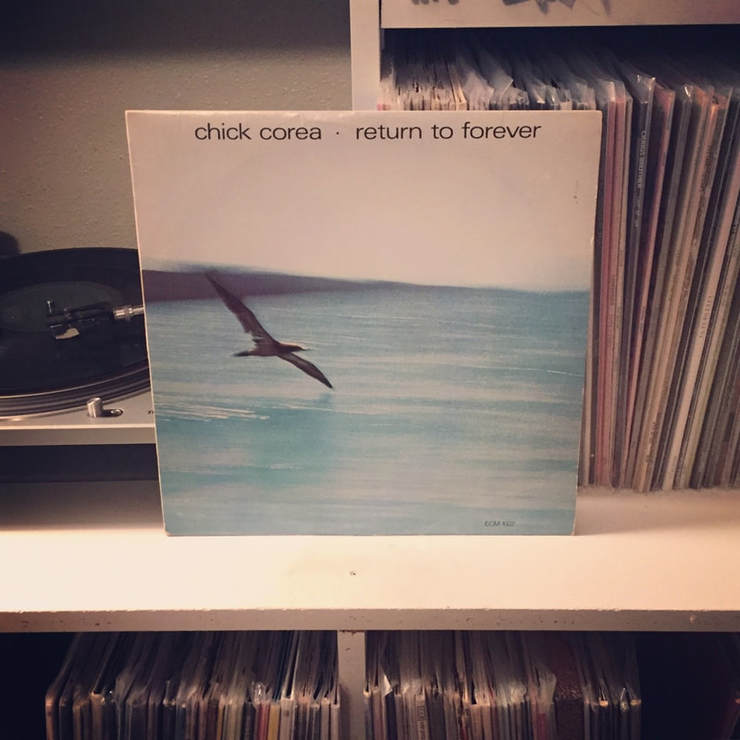
Record #406: Chick Corea – Return to Forever (1972)

Just yesterday, I mentioned that I’ve spent the last few weeks looking into what Miles Davis’ cohorts were up to during his fantastic electric period. While Herbie Hancock was busy launching jazz into space, his best friend Chic Corea was tethering it to the earth.

In the liner notes of this album, Chick says that Return to Forever (which was the group that performed this album, despite it being credit to Chick alone) was born out of a desire to reconnect his jazz explorations with the heart of emotional songwriting. He had gotten a bit lost in his own head, and wanted to put his soul back into music.
And for the most part, this hits that mark. Chick plays a Fender Rhodes throughout the session, without much effects trickery. There’s no shortage of experimental jazz weirdness, but there’s also a fair amount of Latin flair. Oh, and a pop song.

The opener, “Return to Forever” is an incredible, moody twelve-minute piece of space jazz with wordless vocals and a deep samba groove. “Crystal Silence” is an In a Silent Way-esque piece of ambience that finds Chick’s Rhodes accompanied only by Joe Ferrell’s woodwinds. “What Game Shall we Play Today?” is a delightful pop tune that sounds like could be on Sesame Street (note: that is not an insult!).

The closer, “Some Time Ago/La Fiesta” takes up the entirety of side B and manages to revisit every track before it. It opens with an obtuse, ambient section where bassist Stanley Clarke finally gets his day in the sun. It then transitions into a Latin-tinged pop song featuring Flora Purim’s enchanting vocals. After her verses, it becomes a much more aggressive flamenco inspired jam, that ends up nowhere near the place it began.
At times, it runs the risk of sounding dated, or even a little cheesy.

But it somehow transcends the signifiers of its era and manages to become truly timeless. While his contemporaries were getting lost in space or hitching their wagon’s to funk’s swagger, Corea took the road less traveled and made an album that is truly special.

Record #405: Herbie Hancock – Sextant (1973)

As much as I love Miles Davis’ electric period (especially In a Silent Way and Bitches Brew) it’s taken me until the last couple weeks to realize that everyone else in the room with Miles on those records was also making some really out-there music around the same timeframe…
Maybe the most out-there of Miles’ collaborators during this time was the already-legendary Herbie Hancock. Herbie was a pillar in the jazz scene years before Miles invited him into his band. He had proven himself as a master composer (”Maiden Voyage” is a standard for any high school jazz group) and a virtuoso on the piano. But when instrument makers started to expand upon the basic format of the piano itself, Herbie was keen to jump on board. He was an early adopter of the Fender Rhodes, the synthesizer, and tape delay.
While you can hear his love for electric pianos on his work with Miles, his fascination with the boundless possibilities of synthesizers came to a head during his Mwandishi period. While all three of these records (Mwandishi and Crossings being the other two) saw Herbie and Co. pioneering digital landscapes with sheer animalistic delight, that ethos reached its pinnacle on Sextant.
The album opens with “Rain Dance,” a nine minute track that is almost as synth driven as a Kraftwerk tune. Drums are almost absent as the group lets a synthesizer take over on rhythm duties. It’s followed by “Hidden Shadows,” which I swear is a rearrangement of a tune from Miles Davis’ Live-Evil, but I can’t identify it. But it jaunts along with a wicked sounding voodoo funk that Herbie tries to defeat with the only acoustic piano on the record (spoiler alert: he does not defeat the voodoo).
Side B is a single twenty track (not unusual during this period) called “Hornets.” It’s a funky, spaced-out jam that sounds exactly like the cover looks. The band plays in an absolutely tribalistic abandon that sounds exactly how the cover looks. Herbie warps the settings on his tape delay. Bennie Maupin plays a friggin’ kazoo. Buster Williams runs his bass groove through every possible permutation. Billy Hart does all he can on the drums to keep the band from flying off into space. But for all of his effort, he fails: the song still ends up as the theme song for a rave on Mars.
While Herbie would go on to out-funk all the funk guys on Head Hunters, his Mwandishi period produced my undisputed favorite albums in his catalogue. And this record, even more untethered to traditional conventions of jazz, is as good as he gets.

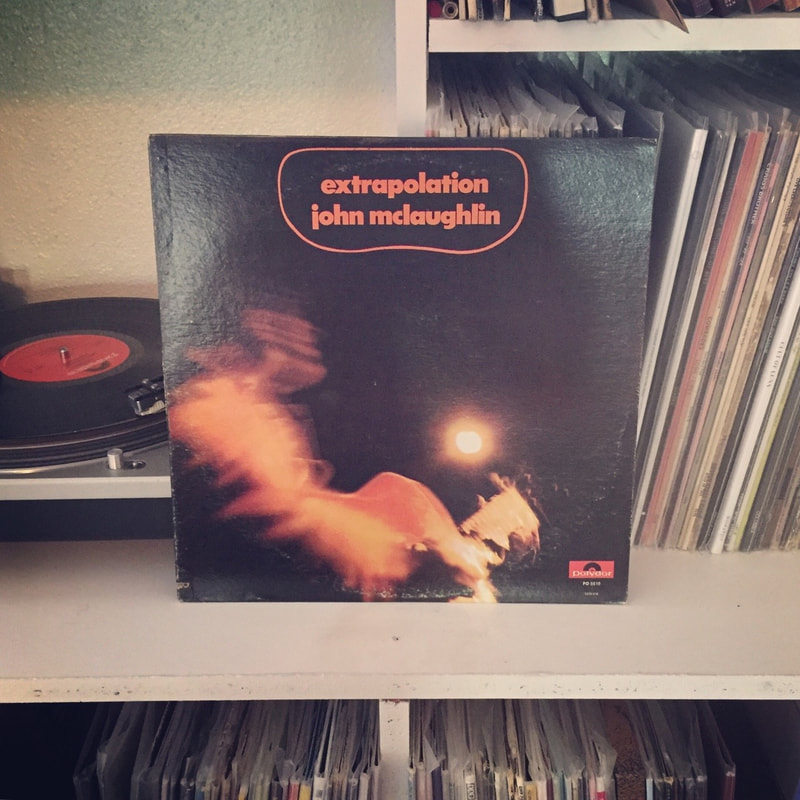
Record #404: John McLaughlin – Extrapolation (1969)

In the late 1960s, Miles Davis was at a crossroads.

His last few albums, Nefertiti, Miles in the Sky, and Filles de Kilimanjaro, found the jazz icon pushing desperately against the conventions of his industry. Nefertiti played with the roles of the traditional jazz combo. Miles in the Sky and Filles saw his rhythm section (including the legend in his own right, Herbie Hancock) moving towards electric instruments. 

While writing the masterpiece In a Silent Way, Miles wanted to do something truly revolutionary (spoiler alert: he succeeded)…
As the legends are told, the night before one of the recording sessions, drummer Tony Williams introduced Miles to newcomer John McLaughlin, an electric guitarist. Miles was so impressed that he invited McLaughlin to the studio the next day. Over the next several years, McLaughlin would become a fixture in Miles’ band. There’s even a song on Bitches Brew named after him. 

But it wasn’t just Miles’ group. John McLaughlin would become a ubiquitous presence in the jazz fusion scene of the 1970s, playing with Larry Coryell, Stanley Clarke, rock giants Jack Bruce and Santana, and leading the power house fusion group Mahavishnu Orchestra. 

And judging by this, his debut album, it’s easy to see why he would become such a giant in the scene. This isn’t nearly as out there as most of what he’d go on to make. Save for his electric guitar, this album is played by a traditional jazz combo—upright bass, saxophone, and drums. There are moments that sound reminiscent of a pre-free Coltrane. 

Until he comes tearing down his fretboard. His playing is mostly tied to conventional jazz technique, especially on the twin lines he plays with the bari sax. But every once in a while, some rock and roll sneaks in. Some of his parts (”Argen’s Bag” in particular) foreshadow some of the more cerebral post rock acts like Tortoise or Collections of Colonies of Bees. 

Often, debut albums from pioneers are little more than a curiosity. They offer glimpses of the genius that is to come, but are still too tied to convention to be satisfying. And in jazz, even the best sidemen have put out mediocre albums as band leaders. But Extrapolation is neither of those. This is a debut befitting his legend. 

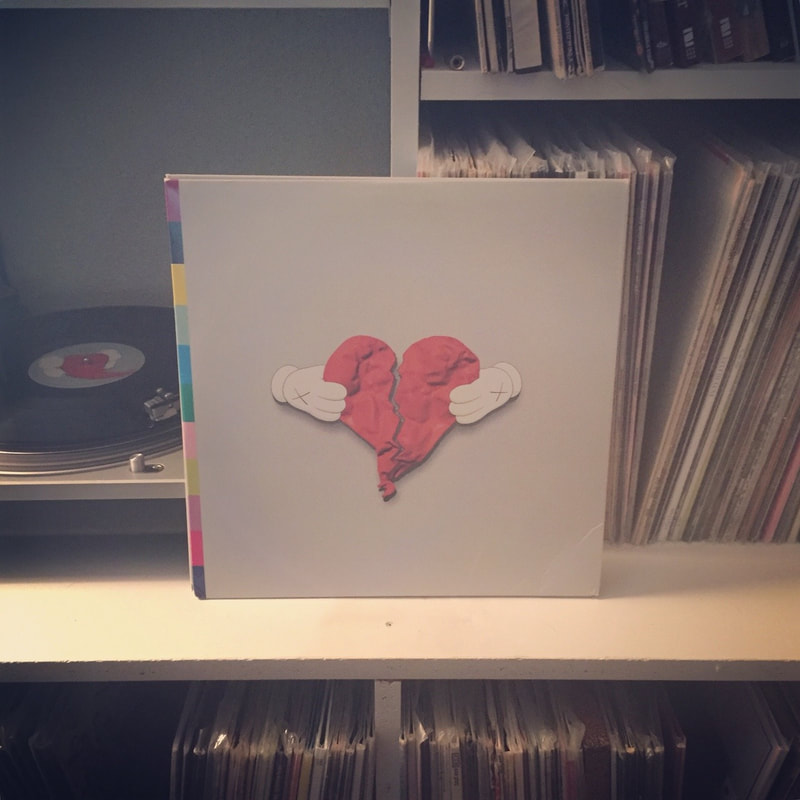
Record #403: Kanye West – My Beautiful Dark Twisted Fantasy(2010)

After a particularly bombastic year of outbursts, Twitter rants, and Grammy interruptions, the world was unsure what a new Kanye record would sound like. His previous album broke a streak of undisputed bangers with an aggressively noncommercial, yet singular focused album. 
Many people said he’d gone off the deep end. His career was on an unrecoverable downward slope. He was a whirlwind of madness, tantrums, and frenzy. His name became a punchline.
Into this mess, Kanye dropped My Beautiful Dark Twisted FantasyIf ever there was a question of Kanye’s skills as a musician, he answers them all here.
MBDTF sees Kanye at top form. His skills as MC, producer, and curator are on top display. 

The album is bookended by two questions: “Can we get much higher?” “Who will survive in America?” The album runs through ego that would make Narcissus blush. And while Narcissus is regaining his composure, Ye turns around and turns to the viewer to display the depths of his depression. It’s littered with lines that land like a suckerpunch. “’How’s Ye doin’?’ I’m surviving. / I was drinking earlier, now I’m driving.” Ouch.

This is an bleak and honest an album as Blood on the Tracks by Bob Dylan, cleverly disguised as a club-ready banger. And his sonic palette is top notch. After the stark minimalism of 808s and Heartbreak, MBDTF is sonically excessive. There are soul horns, lush choirs, a King Crimson sample, a bit of rock and roll, and, famously, a Bon Iver remix. From ballads to bangers, Mr. West hits every box here. 

Despite its commercial friendliness, MBDTF is a challenging and rewarding listen. Despite being only thirteen tracks, this album almost hits seventy minutes in length. None of these songs are rushed. Even the bangers reach the five minute mark. “Runaway,” the first single (released via a short film, remember) breaks nine minutes. It’s a clear message that though West is a master of pop structures and textures, he is by no means bound to pop’s limitations. 

And if that isn’t Kanye West, I don’t know what is. He is the paragon of pop superficiality and celebrity excess, yet he is also an artist of the highest caliber. And between the youthful exuberance of his early albums and the defiantly non-commercial later works, My Beautiful Dark Twisted Fantasy remains his best work.

Record #402: Coheed and Cambria – Good Apollo, I’m Burning Star IV, Volume One: From Fear Through the Eyes of Madness(2005)

I have an odd relationship with this album…
In the spring of 2005, I had a moment where I felt like God wanted me to get rid of all my “nonchristian” music. I drove around dark country streets on the outskirts of my suburb flipping through my CD wallet and throwing discs out the window. Not a very good night for the environment, I know.
That fall, I started at a Christian college, and despite the wealth of secular music available around me (note: not a very conservative college), I had no desire for any of it. Then, the press for this album started coming out. As I’ve mentioned before, Coheed and Cambria was one of my favorite bands in high school. And while I had been satisfied to ignore them during the months prior, the idea of new Coheed made me have second thoughts.
And brother, I prayed about that mess. I asked God about it, and after a few weeks of prayer, and one week of fasting from any music (brother, it was a hard week), I felt like I had the freedom to make my own choice. 
The following week, I let myself listen to The Mars Volta, and during the opening moments of Deloused in the Comatorium, the presence of God fell heavy on my dorm room. And in that moment, I realized that the line between the sacred and the secular was bullshit, and that God could be found anywhere.
That moment has informed almost all of my listening habits, and much of my personal worldview. And it was this album that spurned me to look beyond my self-imposed confines.

That being said, I haven’t actually spent much time with this album. I think the first time I listened through the entire time was just a few days ago (I never had the patience for the Wishing Well suite). 
Don’t get me wrong: I absolutely love this record. The triple punch of Always & Never, Welcome Home, and Ten Speed (of God’s Blood and Burial) is absolutely perfect. And the album doesn’t really slope off after that. The entire disc (even Wishing Well, as I know now) is a masterpiece. Like In Keeping Secrets, this album finds Claudio & Co. churning out track after track of their hook-laden progressive metal. 
Read that again. I swear it’s not an oxymoron.
Usually, progressive metal concept albums about comic books written by the lead singer aren’t this catchy. Tunes like “The Suffering” and “Once Upon Your Dead Body” are straight up pop-rock master strokes. “Welcome Home” recaptures the spirit of Led Zeppelin’s “Kashmir,” and doesn’t leave wanting. Ballads like “Always & Never” and “Welcome Home” were pulled straight of some hair metalist’s notebook. If this album isn’t as good as In Keeping Secrets, it’s just a notch below. Good Apollo is certainly mixed better though.
And so while I’ve never taken the time to properly get to know this album, I’m looking forward to it. Like a kid in high school that I never really talked to but I just knew was super cool, only to build a close friendship with them later in life. That happens, right?

Record #401: Kanye West – 808s and Heartbreak (2008)

There’s almost no artist quite as polarizing as Kanye West. From his Reality TV wife to his maelstrom of a Twitter feed, Mr. West is a pretty big pill for some people to swallow. But early in his career, his music was one thing that people mostly agreed on. His first few records were excellent and clever, but not too adventurous. He had his sights set on mainstream hip-hop, and he delivered.

Then came 2008… 

A few months after his model fiancé broke up with him, his beloved mother passed away. While Ye had never shied away from vulnerability in his previous records, these personal tragedies found him even more introspective. 

The subject matter was paired with a very specific aesthetic: all of the songs are sung, not rapped, drenched in autotune, accompanied by a retro Roland 808 drum machine. The resulting record is basically a concept album—and one that a lot of Kanye’s previous fans hated.

The autotune in particular was a sticking point for people. Why sing an entire album if you can’t sing? But naysayers missed that the effect’s use was entirely aesthetic. Such heartwrenching tunes sung in a robotic vibrato creates a powerful aural irony that makes these songs more affecting, not less. Anyone who wrote the album off also missed Kanye’s incredible sense of melody. The tunes he writes here are engaging and catchy. 
By all accounts, this album should not have worked. But its limited sonic palette and narrow subject matter ended up creating a laser focused album that succeeds because of its singular vision. 

And if this album set the stage for a Kanye that was completely unconcerned with satisfying cultural expectations for his output, all the better.

Record #400: Kansas – Point of Know Return (1977)

This is a milestone—as of this post, I am undeniably halfway through my collection. I guess you could say I’m…

Past the point of no return?

Bad puns aside, I suppose the point Kansas is referring to is their transition from exploratory prog rock to more streamlined pop tunes…
Only two songs on this album stretch past five minutes (compared to half of the tunes on Leftovertures).
There’s no shortage of instrumental jam sections, but even those moments have a radio-friendly sheen on them. It may have done in an attempt to make The possible exception is the title track, with a flurry of orchestral riffs between lines in the chorus.

On the longer songs, “Closet Chronicles” and “Hopelessly Human,” the group gives themselves permission to get proggy. Through their long runtimes, the group changes tempo, mood, and style on a dime.  

The natural standout is the heartbreaking ballad “Dust in the Wind.” However, it doesn’t have the potential it could have on a truly great album. This sort of track would do great as a penultimate track on a concept album: a deep breath before the storm of the finale. Here, it’s just a pretty detour. 

All of this isn’t to say that prog bands should stay away from pop. GenesisThe Alan Parsons Project, and Yes all turned their progressive leanings into pop masterpieces with stunning success. Kansas falls a little short—even if this is, apparently, most people’s favorite Kansas album?

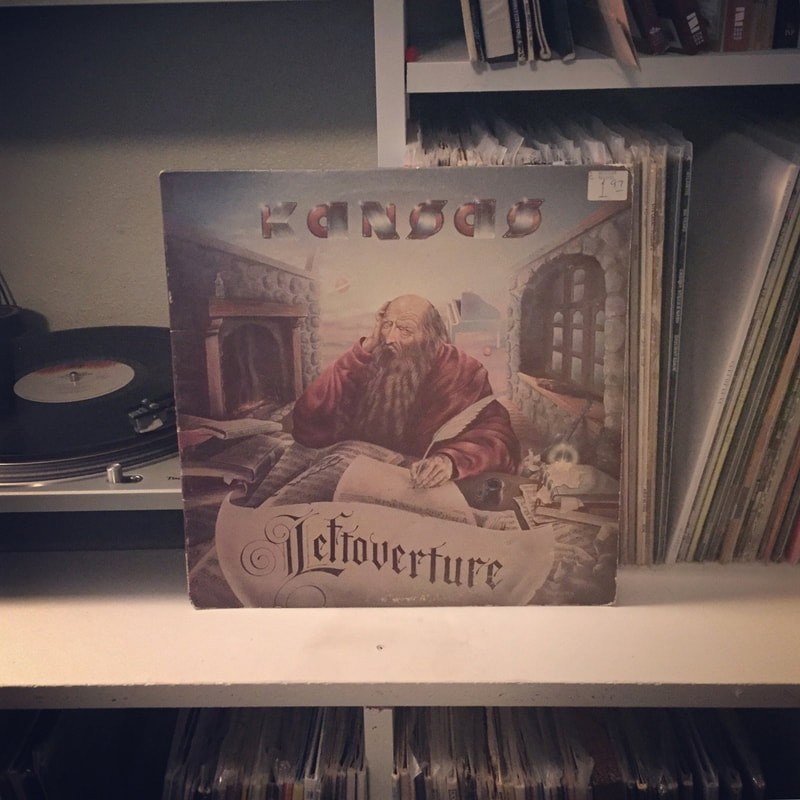
Record #399: Kansas – Leftoverture (1976)

Prog rock has gotten a bad rap.

Prog is often criticized for being bloated, self-important, and pretentious. At its worst, prog is obsessed with self-gratifying instrumental sections, musical references to classical compositions, and obtuse narratives of their own writers’ inventions…

And while all of that is certainly true of this record, it doesn’t mean it isn’t fun. And this album’s popularity certainly shows it—this record has been through almost every record collection on earth.

The lead opener, the famed “Carry On the Wayward Son” is the most immediate track. But it doesn’t go easy on the prog tendencies—half of its five minutes are spent ripping through solos.

It’s a good look at what to expect, but don’t expect the rest of the songs to rock this hard. Hooks (and vocals in general) are far and few between on this album, saddled between lengthy instrumental passages that are, if nothing else, deftly played, traveling everything from baroque to metal. There are even a couple spots that feel a bit hoedowny.

While most of the tracks sound like they could have been radio hits in the 70s, the closer, “Magnum Opus” goes full prog. It’s a six movement suite that breaks eight minutes—most of that time spent without vocals. Is it bloated and self-important? Sure. But’s it’s hella fun too.

And that’s the story of this record. It indulges in all of prog rock’s cardinal sins, and still manages to be an enjoyable listen. Nowhere near as painful as certain other prog records.