While Slow Train Coming saw Dylan expanding his folk palette with progressive rock and gospel colors, Saved is almost exclusively a gospel record. The restraint shown by its predecessor is often shed entirely, and background singers, Hammond organs, pounded pianos, and raucous tempos are par for the course here, with Dylan himself even improvising vocal fills between lines like he’s wearing a robe and swaying along in the choir box. Continue reading
Author: Nathaniel FitzGerald
Record #61: Bob Dylan – Slow Train Coming (1979)
Just about everybody thinks of Slow Train Coming as Bob Dylan’s first record after becoming a Christian*. And while that’s certainly true, and while that makes it a milestone, it often undermines the value of the music therein, which is understatedly magnificent.
Record #60: Bob Dylan – Desire (1976)
After the heavy intimacy of Blood on the Tracks, Dylan cowrote an album (a first for him, I believe) that returned to the outlaw hymns of John Wesley Harding, raging against the establishment and racism put to acoustic guitar, drums, and a violin, which proves a fitting companion for Dylan’s scraping guitar, ragged vocals, and howling harmonica.
Record #59: Bob Dylan – Blood On The Tracks (1975)
As I had mentioned earlier, breakup records are an important pop music tradition, and Blood on the Tracks is the archetype for the genre. The record finds Dylan in the studio without the Band for the first time in years and returning to the lyric-heavy writing of his earlier material, leading to his first 7min+ running times since Blonde on Blonde.
Record #58: Bob Dylan – Bob Dylan’s Greatest Hits, Vol. II (1971)
Amidst a critical and commercial slump and rumors that he had no plans to record a new LP, CBS record execs (with Dylan’s blessing) set to making money off of their golden goose, leading to this two disc collection. The result is a truly worthwhile look at a proper genius’s full career, including cuts from just about every album he had released up to that point (excepting his debut, Times, and his critically panned Self Portrait) as well as seven unreleased tunes, including the sneering rocker Watching the River Flow and the legendary Quinn the Eskimo.
Record #57: Bob Dylan – Nashville Skyline (1969)
It’s difficult for me to listen to this album as anything more than as an interesting one-off. Though excellent, it’s so far out of character for Dylan. Nowhere does he throw acid or even point fingers–his love songs are largely free of suspicion and fatalism. He even sings differently. It’s no doubt because of this that the album became one of his greatest commercial successes. And while it’s fun to hear Bob Dylan write and sing country songs, the album’s 27 minute length seems to know that the novelty would only last so long, ending before the joke gets old. It’s a wise decision, and one that legend tells would be forgotten on Dylan’s next album as he tried to repeat it.
Record #56: Bob Dylan – John Wesley Harding (1967)
1967 was a year that saw a great deal of experimentation in rock music. Pink Floyd released Piper at the Gates of Dawn, which had a strong influence on the psychedelic turns on Sgt. Pepper and The Who Sell Out. Even Brian Wilson was flexing his muscles with his ambitious Smile project.
Bob Dylan, meanwhile, took back his acoustic guitar and focused on a more functional style of songwriting.
Record #55: Bob Dylan – Blonde on Blonde, 1966
According to Wikipedia, Blonde on Blonde is the final album in what is largely considered to be his Rock Trilogy. When I read that, I was shocked that I hadn’t noticed it before. While Bringing It All Back Home and Highway 61 Revisited have always struck me as different sides of the same coin, Blonde on Blonde seemed a different monster altogether.
Record #54: Bob Dylan – Highway 61 Revisited (1965)
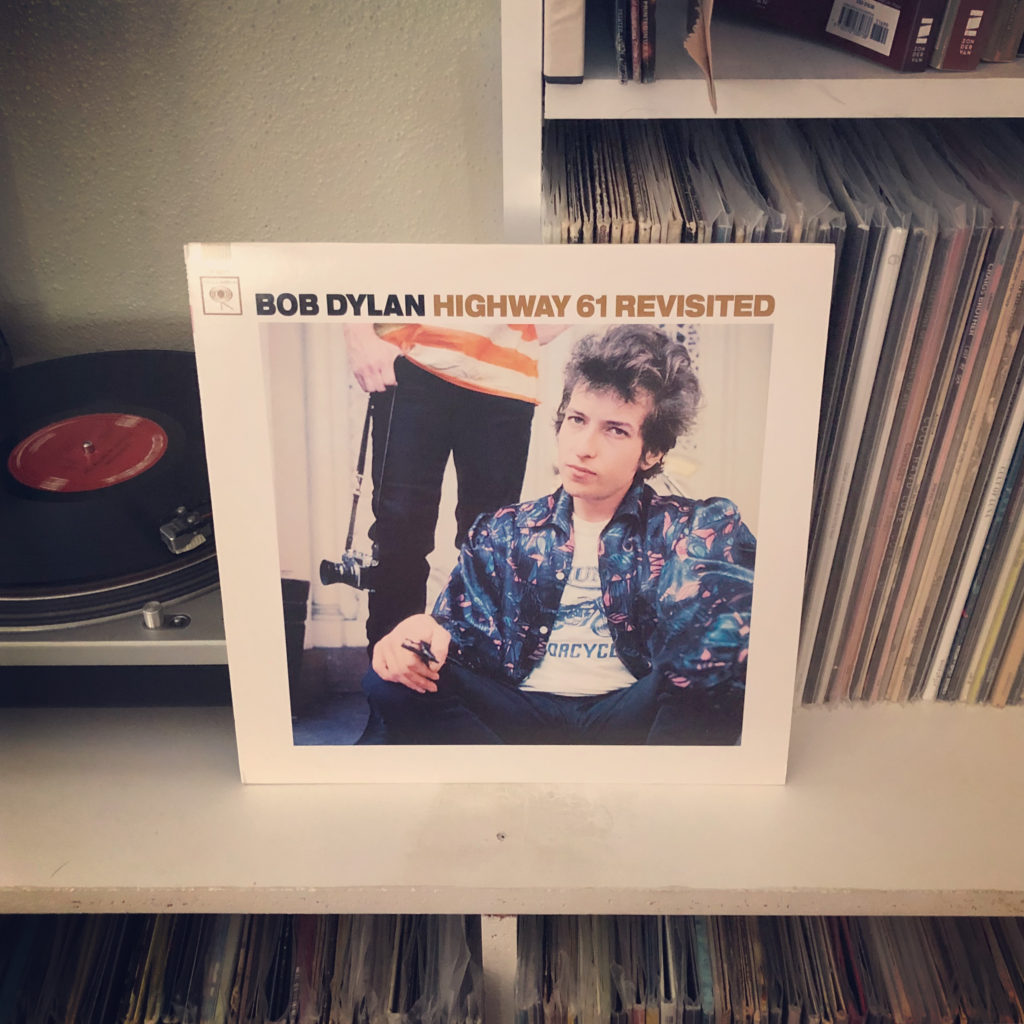 Despite his affirmation of Highway 61’s significance as the trotting grounds of country blues legends, this album ends up being just as ironically titled as Bringing It All Back Home, on which Dylan brought just about nothing “Home,” but fled from his roots in a fury of rock bands and surrealism. In many ways, Highway 61 Revisited is Home’s Amnesiac–a further exposition on a previous album that had more to say than one groundbreaking album could say. Continue reading
Record #53: Bob Dylan – Bringing It All Back Home (1965)
On Bob Dylan’s first four releases, the production was incredibly simple–a man with an acoustic guitar (or piano, occasionally) and harmonica sang songs at a single microphone with no overdubs.
And then, Dylan lashed out.
Subterranean Homesick Blues starts with a single harmonica that is immediately joined by a drum set, bass guitar, piano, and no fewer than two electric guitars. And instead of the socially conscious lyrics that made him the Spokesman of a Generation, here he spits nonsensical couplets (Don’t follow leaders/watch the parking meters), and when he is being coherent, he’s railing against that Spokesman position.